
Foundations are essential for ensuring the stability and durability of any construction project. A solid foundation supports the structure above, preventing movement or settlement. In areas such as Essex, Waltham Abbey, and Epping, foundation methods like deep foundation piling are commonly used, especially when the soil conditions require extra support.
Piling involves driving piles into the ground to reach more stable soil or bedrock, making it an ideal solution for structural foundation services in locations with challenging ground conditions. In Waltham Abbey, for instance, driven piles provide the strength needed to support both residential and commercial projects. Meanwhile, piling and slab foundations in Epping combine the benefits of both techniques, offering an adaptable and robust base.
For those looking for expert piling contractors in London, reliable services are available to ensure proper installation and compliance with local building regulations. Whether you're working on a small-scale project or a large development, proper foundation work is crucial for maintaining structural integrity and preventing long-term issues.
What is a Foundation and Why is It Crucial?
A foundation is the base structure that supports a building, transferring the weight to the ground below. It plays a critical role in ensuring the stability and longevity of the construction. In areas like Essex, Waltham Abbey, and Epping, where soil conditions may vary, different types of foundations are required to offer the necessary support. For example, deep foundation piling is commonly used in Essex to reach stable soil layers, while driven piles are ideal for projects in Waltham Abbey that require additional strength.
Below is a table summarising the foundation types and their common use in various locations:
| Location | Foundation Type | Description |
| Essex | Deep Foundation Piling | Used to reach stable soil layers for strong support. |
| Waltham Abbey | Driven Piles | Ideal for areas with unstable ground conditions needing extra support. |
| Epping | Piling and Slab Foundations | A combination of piles and concrete slabs for both residential and commercial projects. |
By choosing experienced piling contractors in London, you ensure that the foundation work is done correctly, promoting the long-term stability and safety of the structure. Proper foundation installation is crucial to prevent issues like shifting, settlement, or structural damage.
The Role of Piling in Foundation Construction
Piling is essential in foundation construction, especially when soil conditions are not suitable for traditional foundations. It involves driving or drilling piles into the ground to provide additional support for buildings. In areas like Essex, Waltham Abbey, and Epping, different piling methods are employed to ensure that the foundation is strong and stable.
Key aspects of piling in foundation construction include:
- Deep Foundation Piling in Essex: Utilised when the surface soil is too weak, ensuring stability by reaching deeper, more stable layers.
- Driven Piles in Waltham Abbey: Ideal for areas with soft or unstable soil, offering robust support for various types of construction.
- Piling and Slab Foundations in Epping: A combination of piles and concrete slabs provides a solid, adaptable base for both residential and commercial buildings.
By working with professional piling contractors in London, you ensure that foundation work is executed properly, reducing the risks of shifting or settlement. Structural foundation services in Waltham Abbey offer tailored solutions to meet specific site conditions, ensuring long-term stability.

What Are the Different Types of Foundations in Construction?
Foundations are essential to providing a stable base for a building. They ensure the weight of the structure is transferred to the ground, preventing settlement or shifting. Different types of foundations are used based on soil conditions, project size, and structural requirements.
Types of Foundations:
- Shallow Foundations:
These foundations are typically used for lighter structures and are installed near the surface of the soil. They include:- Strip Footings: Used for supporting walls and evenly distributing the load.
- Slab Foundations: Commonly used in Epping, piling and slab foundations combine the strength of piles with the stability of a concrete slab for both residential and commercial projects.
- Deep Foundations:
These are necessary when the surface soil is unstable or too weak to support a building. Deep foundation piling ensures that the foundation reaches stable soil or bedrock below. This method is often used in areas like Essex, where surface soil conditions vary. - Piling:
Driven piles in Waltham Abbey are ideal for areas with soft or unstable ground, offering support by anchoring the building to deeper, more stable layers. Piling contractors in London specialise in providing these services to ensure long-lasting stability.
Structural foundation services in Waltham Abbey help clients choose the best foundation type based on site conditions, ensuring safety and durability for the building.
Shallow Foundations: When and Why to Use Them?
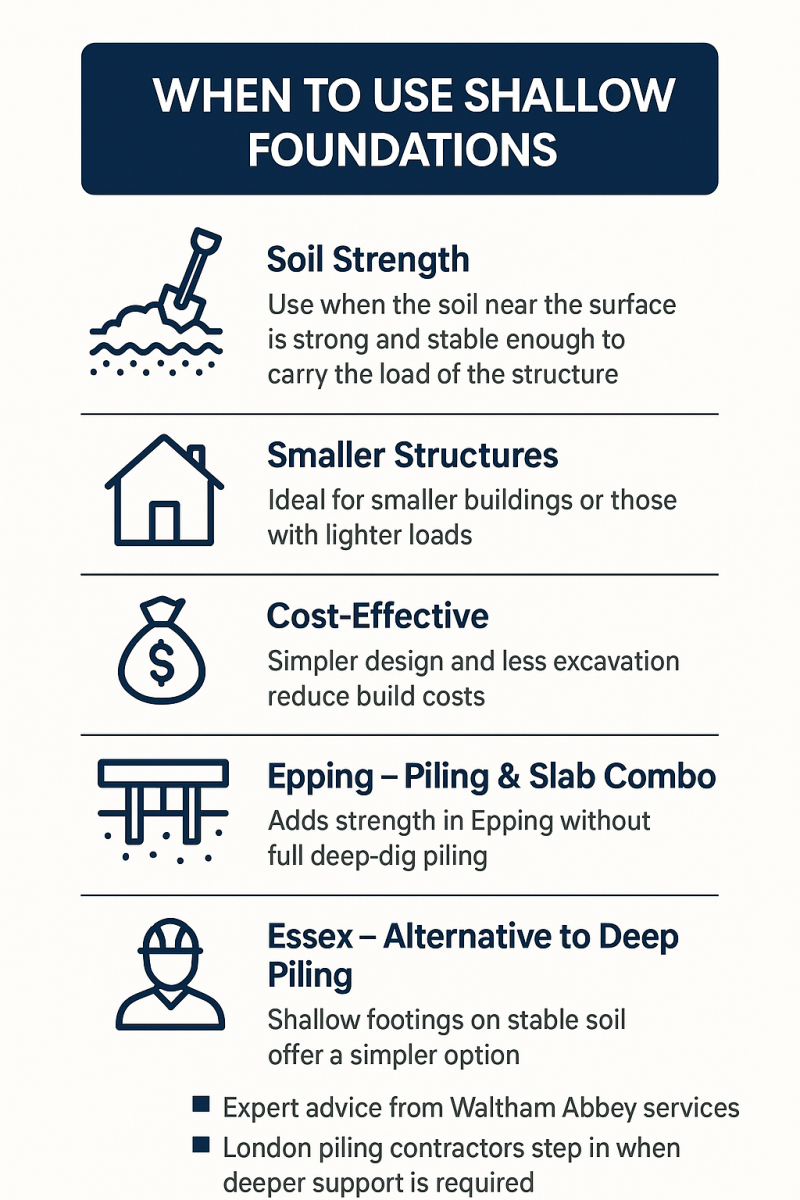
Shallow foundations are used when the surface soil is capable of supporting the structure’s weight. These foundations are placed near the surface, making them ideal for certain types of buildings. Here’s why they are commonly used:
When to Use Shallow Foundations:
- Soil Strength: Shallow foundations are suitable when the soil near the surface is strong and stable enough to carry the load of the structure.
- Smaller Structures: They are ideal for smaller buildings or those with lighter loads.
- Cost-Effective: Since shallow foundations are simpler and require less excavation, they are more cost-effective compared to deep foundations.
Why Shallow Foundations Are Used:
- Piling and Slab Foundations in Epping: In areas like Epping, a combination of shallow foundations with piling offers added strength without the need for deep excavation.
- Alternative to Deep Foundation Piling in Essex: For projects in areas where the surface soil is stable, shallow foundations provide a simpler, more efficient option compared to deep foundation piling.
- Local Expertise: Structural foundation services in Waltham Abbey offer guidance on whether shallow foundations are suitable for your project, while piling contractors in London can help if deeper support is needed.
Shallow foundations are a reliable choice for appropriate sites, providing a solid, economical base for many types of construction.
Deep Foundations: When and Why Piling is Needed?
Deep foundations are necessary when the surface soil cannot provide sufficient support for a structure. Piling is used to reach deeper, more stable soil layers, ensuring long-term stability for the building.
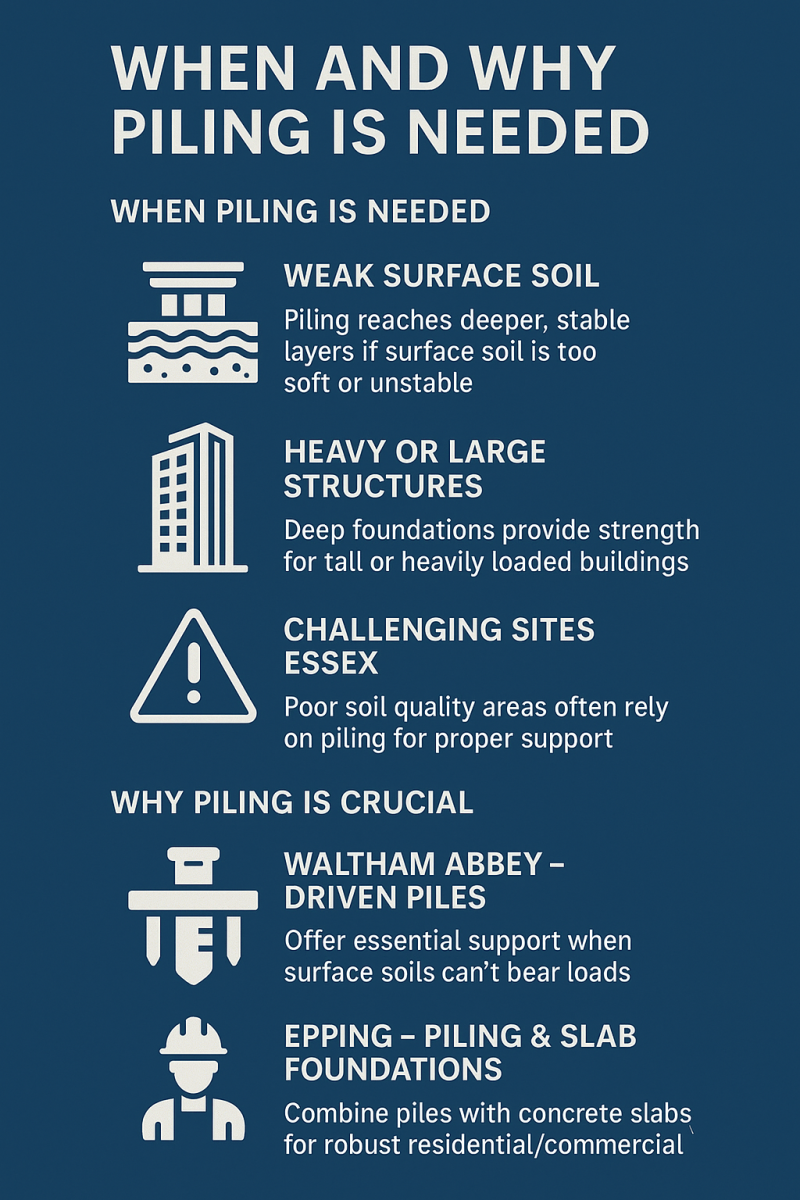
When Piling is Needed:
- Weak Surface Soil: If the surface soil is too soft or unstable, piling reaches deeper layers that are more capable of supporting the weight of the structure.
- Heavy or Large Structures: For buildings with heavy loads or tall structures, deep foundations offer the required strength and stability.
- Challenging Site Conditions: Areas with poor soil quality, such as Essex, often rely on deep foundation piling to ensure proper support.
Why Piling is Crucial:
- In Waltham Abbey, driven piles provide the necessary support when the surface soil cannot bear the load.
- Piling and slab foundations in Epping combine piles with concrete slabs, creating a robust foundation for both residential and commercial buildings.
- Piling contractors in London and structural foundation services in Waltham Abbey offer expert solutions tailored to specific site conditions, ensuring the right foundation choice for your project.
Piling is essential for ensuring the stability and safety of buildings in areas with unstable soil, making it a crucial element of foundation construction.
What Are Piling Foundations and How Do They Work?
Piling foundations are a critical component of construction, providing deep support when surface soil conditions are not strong enough to bear the load of a building. Piles are driven or drilled deep into the ground to reach stable soil layers or bedrock.
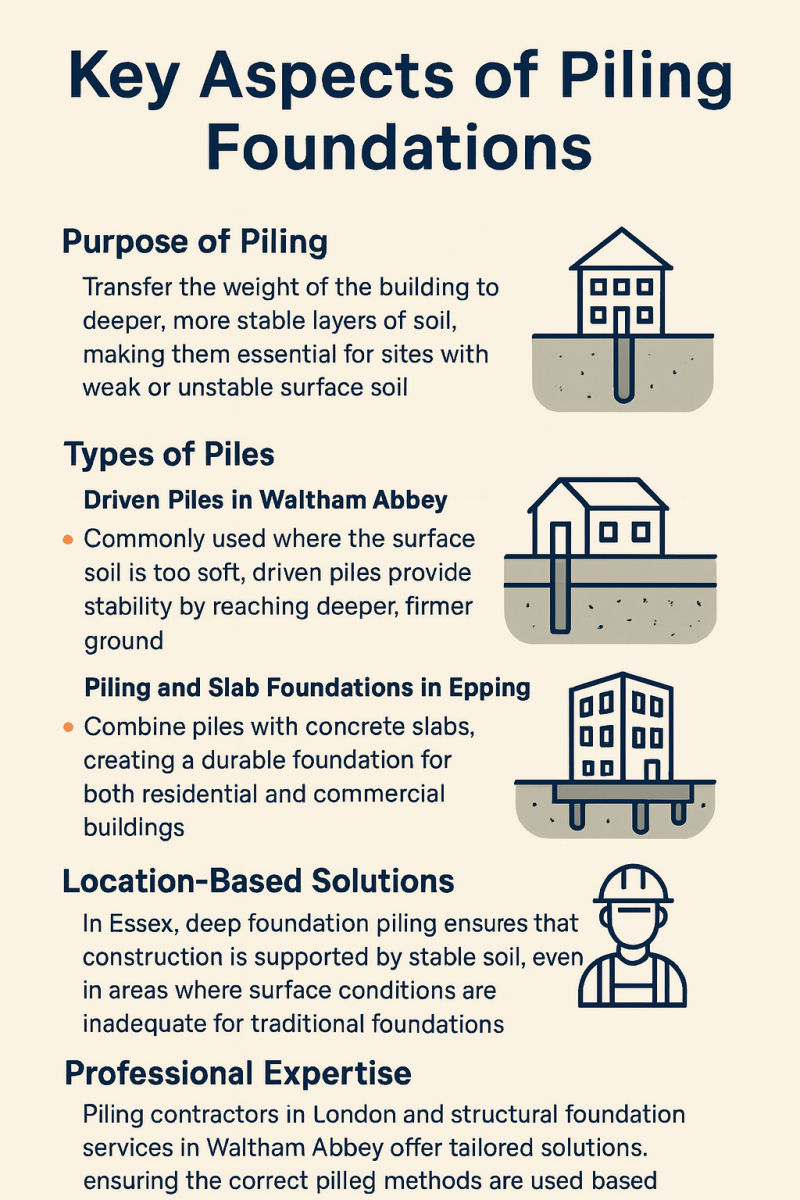
Key Aspects of Piling Foundations:
- Purpose of Piling:
Piling foundations transfer the weight of the building to deeper, more stable layers of soil, making them essential for sites with weak or unstable surface soil. - Types of Piles:
- Driven piles in Waltham Abbey: Commonly used where the surface soil is too soft, driven piles provide stability by reaching deeper, firmer ground.
- Piling and slab foundations in Epping: Combine piles with concrete slabs, creating a durable foundation for both residential and commercial buildings.
- Location-Based Solutions:
In Essex, deep foundation piling ensures that construction is supported by stable soil, even in areas where surface conditions are inadequate for traditional foundations. - Professional Expertise:
Piling contractors in London and structural foundation services in Waltham Abbey offer tailored solutions, ensuring the correct piling methods are used based on site-specific conditions.
Piling foundations are vital for ensuring the long-term stability and safety of buildings, particularly in areas with challenging soil conditions or heavy construction.
What Are the Various Types of Piles Used in Construction?
Piles are an essential part of foundation work, used to transfer the weight of a structure to deeper, more stable layers of soil or bedrock. There are several types of piles, each suited to specific site conditions and construction requirements.
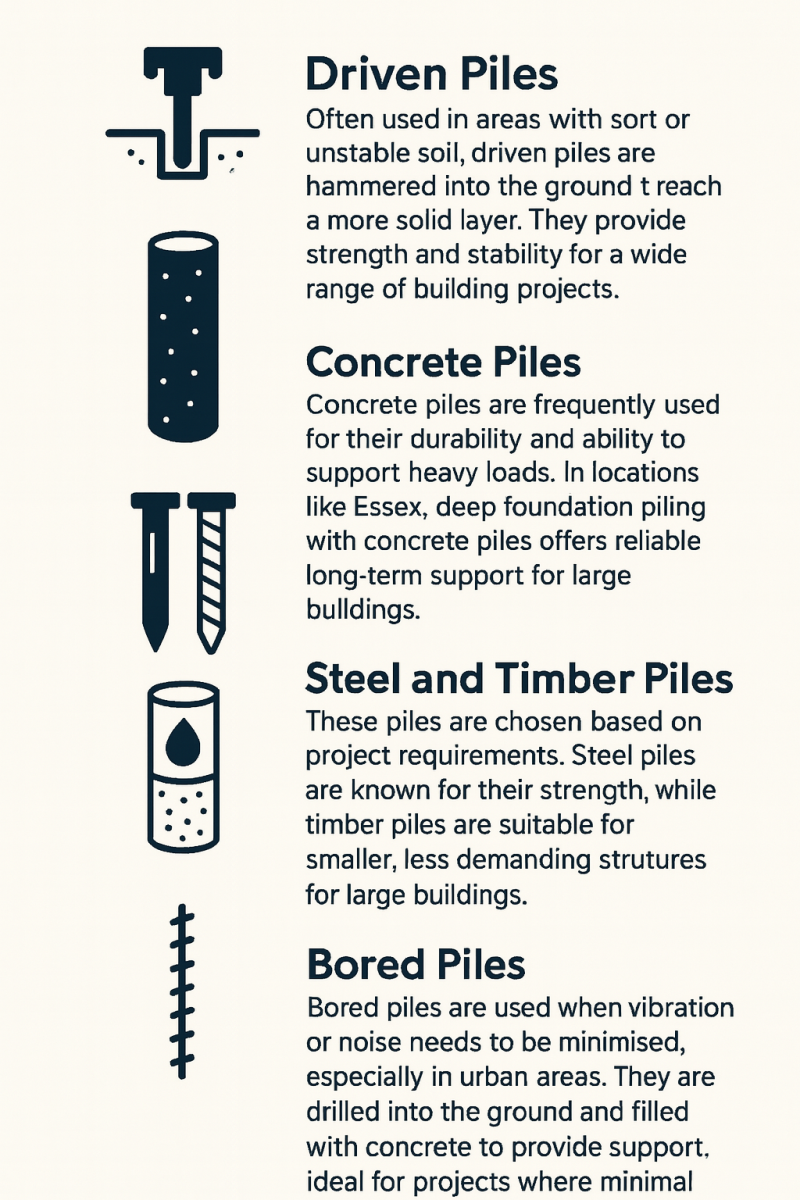
Common Types of Piles:
- Driven Piles:
Often used in areas with soft or unstable soil, such as Waltham Abbey, driven piles are hammered into the ground to reach a more solid layer. They provide strength and stability for a wide range of building projects. - Concrete Piles:
Concrete piles are frequently used for their durability and ability to support heavy loads. In locations like Essex, deep foundation piling with concrete piles offers reliable long-term support for large buildings. - Steel and Timber Piles:
These piles are chosen based on project requirements. Steel piles are known for their strength, while timber piles are suitable for smaller, less demanding structures. - Bored Piles:
Bored piles are used when vibration or noise needs to be minimised, especially in urban areas. They are drilled into the ground and filled with concrete to provide support, ideal for projects where minimal disruption is required. - Micropiles:
Micropiles are small-diameter piles used in areas with limited space or challenging soil conditions. They are highly flexible and can be installed in confined spaces, making them ideal for repair or retrofitting projects. - Piling and Slab Foundations:
In areas such as Epping, piling and slab foundations combine the strength of piles with a concrete slab, providing an adaptable and stable base for both residential and commercial buildings.
Choosing the right type of pile is crucial to the success of a construction project. Understanding the site conditions and the load requirements will help determine the most suitable piling solution.
How Piling Works in Construction?
Piling is an essential method used in construction to provide support for structures when surface soil conditions cannot bear the required load. The piles are driven or drilled deep into the ground, reaching stable layers of soil or bedrock. This ensures the foundation remains strong and secure, especially for large or heavy buildings.
Here is a breakdown of how piling works in different locations and contexts:
| Location | Piling Type | Description |
| Essex | Deep Foundation Piling | Used to reach stable layers deep underground, ideal for larger structures. |
| Waltham Abbey | Driven Piles | Hammered into the ground to secure the structure to solid, load-bearing soil. |
| Epping | Piling and Slab Foundations | Combines piles with a concrete slab, providing a strong, adaptable base for buildings. |
| London | Piling Contractors | Professionals who provide tailored piling solutions based on site conditions. |
In areas such as Waltham Abbey and Epping, piling techniques are chosen based on soil conditions to ensure stability. Piling contractors in London are experts in determining the best solution for specific site needs. This approach ensures long-lasting stability for buildings, even in challenging environments.
How Does the Piling Process Work and What Equipment is Used?
The piling process involves driving or drilling piles into the ground to reach more stable layers of soil or bedrock. It provides essential support for buildings when the surface soil is unable to bear the load. In locations like Essex, deep foundation piling ensures that structures are securely anchored to stable ground.
Key Equipment Used in the Piling Process
| Piling Equipment | Description | Common Location |
| Pile Drivers | Machines used to drive driven piles in Waltham Abbey into the ground using force. | Waltham Abbey, Essex |
| Boring Machines | Used to drill holes for piles, especially for piling and slab foundations in Epping, which are then filled with concrete. | Epping |
| Hydraulic Rigs | Heavy equipment used for installing various types of piles, especially in deep foundations. | Essex, London |
Piling contractors in London assess the site conditions to determine the most suitable equipment for the job. Structural foundation services in Waltham Abbey ensure that the appropriate piling methods are chosen, guaranteeing long-lasting stability for any structure.
What Are the Key Differences Between Shallow Foundations and Piling?
Shallow foundations and piling both serve to provide structural support, but they differ in how they interact with the ground and the conditions under which they are used.
Key Differences
| Foundation Type | Used When | Common Locations | Description |
| Shallow Foundations | When surface soil is strong enough to bear the load | Epping | Shallow foundations are placed near the surface and used for lighter structures. Often combined with piling and slab foundations for added support. |
| Piling | When surface soil is weak or compressible | Essex, Waltham Abbey | Piles are driven deep into the ground to reach stable soil or bedrock. Common in areas like Waltham Abbey, where driven piles are necessary for structural stability. |
Both foundation types are vital for ensuring the long-term stability of a building, with structural foundation services in Waltham Abbey and piling contractors in London offering tailored solutions based on the site’s specific conditions.
What Site and Soil Conditions Are Important for Foundations and Piling?
The choice of foundation type depends on the characteristics of the soil and the site's stability. In areas with stable surface soil, shallow foundations are suitable, but in areas with weak or compressible soil, piling becomes essential for support.
Site and Soil Considerations
| Site Condition | Foundation Type | Common Locations | Description |
| Stable Surface Soil | Shallow Foundations | Epping | Suitable for lighter buildings when the surface soil can bear the load. Piling and slab foundations combine piles with a slab for added strength. |
| Weak or Compressible Soil | Deep Foundation Piling | Essex, Waltham Abbey | Deep foundation piling is used to reach stable soil layers. In Waltham Abbey, driven piles anchor buildings to firmer ground. |
Piling contractors in London and structural foundation services in Waltham Abbey assess the soil conditions to determine the most suitable foundation type, ensuring long-term stability for any construction project.
What Materials Are Used for Foundations and Piling?
The materials chosen for foundation and piling work are critical to ensuring the structure’s strength and stability. Different types of foundations and piling require specific materials based on the site's conditions and the building’s requirements.
Materials Used for Foundations and Piling
| Material | Foundation Type | Common Locations | Description |
| Concrete | Deep Foundation Piling, Slab Foundations | Essex, Epping | Concrete is used for its strength and durability, ideal for both deep foundation piling in Essex and piling and slab foundations in Epping, providing a solid base for large structures. |
| Steel | Driven Piles | Waltham Abbey, London | Steel piles are commonly used in areas with unstable soil, such as driven piles in Waltham Abbey, offering strong support for heavier structures. |
| Timber | Shallow Foundations, Light Piles | Various locations | Timber is used for lighter structures or where soil conditions are stable, providing an economical and environmentally friendly option. |
By choosing the appropriate materials for the foundation, piling contractors in London and structural foundation services in Waltham Abbey ensure that the foundation is both strong and suitable for the site conditions, enhancing the building's stability and longevity.
What Are the Most Common Mistakes in Foundation and Piling Construction?
Proper foundation and piling construction are critical to the stability and safety of a building. Several common mistakes can undermine a project if not properly addressed.
Common Mistakes in Foundation and Piling Construction
| Mistake | Description | Common Locations | Impact |
| Incorrect Pile Selection | Using the wrong pile type, such as shallow foundations when deep piling is needed. | Essex, Waltham Abbey | Can lead to settlement, instability, and increased long-term costs. |
| Inadequate Site Assessment | Failing to assess soil conditions properly, leading to poor foundation choices. | Waltham Abbey, Epping | Can result in incorrect piling or foundation types, risking structural damage. |
| Poor Quality Materials | Using substandard materials for piling or slab foundations. | Essex, Epping | Weakens the foundation, leading to cracks or uneven settling. |
| Lack of Professional Expertise | Not hiring experienced piling contractors or foundation services. | London, Waltham Abbey | Results in improper installation, leading to costly repairs and safety risks. |
By working with skilled piling contractors in London and structural foundation services in Waltham Abbey, these common mistakes can be avoided, ensuring the stability and longevity of the building.
Choosing the correct foundation and piling method is essential for the stability and longevity of a building. The decision largely depends on the site’s soil conditions, the building's size, and the load it needs to support. In areas like Essex, deep foundation piling is often necessary to reach stable ground when surface soils are not suitable. Similarly, driven piles in Waltham Abbey are ideal for unstable soil, providing solid support for structures.
For projects in Epping, piling and slab foundations offer a reliable solution, combining the strength of piles with the stability of a concrete slab. Engaging with experienced piling contractors in London and structural foundation services in Waltham Abbey ensures the right choice of foundation type, tailored to the specific site conditions. This professional guidance will lead to a foundation that offers long-term support and security for the building.
Frequently Asked Questions
What is the difference between piling and foundation?
Piling is a method used to create deep foundations by driving or drilling piles into the ground to reach stable soil or bedrock. A foundation is the base that supports a structure, which can be either shallow (near the surface) or deep (requiring piles).
What are pile foundations?
Pile foundations are deep foundations that use long, slender columns (piles) driven or drilled into the ground to support heavy structures, especially when surface soil conditions are unsuitable.
What are the three types of piling?
The three main types of piling are:
- Driven piles: Hammered into the ground.
- Bored piles: Drilled into the ground and filled with concrete.
- Micropiles: Small-diameter piles used for confined spaces or repair work.
What is the difference between pile and deep foundation?
A pile foundation is a type of deep foundation. While a deep foundation refers to any foundation that reaches significant depth (beyond the surface layer), pile foundations specifically use piles to transfer the load to deeper, stable soil or bedrock.


